
Mid-Level – Temperature

In the previous lesson, geopotential heights were discussed. In this lesson, 500mb temperatures will be covered as they relate to evolving storm systems. 500mb temperatures are plotted in the red numbers in the example analysis above. Lines of constant temperature are contoured with dashed red lines every 2 degrees Celsius. These values plotted on these upper-air maps are taken directly from the observed soundings which are taken every 12 hours across the United States by launching weather balloons. For example, the -20 degrees Celsius temperature in Norman, OK should correspond to the actual 500mb temperature on the observed sounding for Norman, OK.
Plotting the 500mb temperatures is important to understand whether warm air advection or cold air advection is occurring in the mid-levels. If the plotted wind barbs show air flowing from cooler temperatures to warmer temperatures, then cold air advection would be occurring in that area. If the plotted wind barbs show air flowing from warmer temperatures to cooler temperatures, then warm air advection would be occurring in that area. Warm air advection is more closely associated with the potential for precipitation and thunderstorms, whereas cold air advection would often not be supportive for thunderstorms.

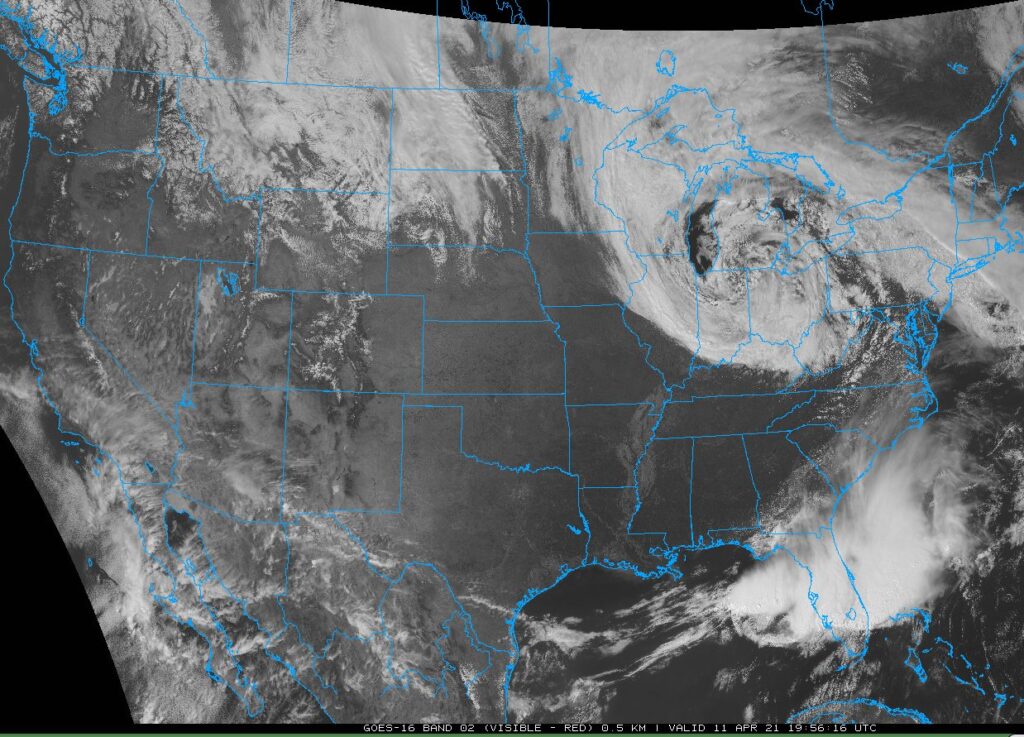
On the left is the 500mb analysis with cold air advection (CAA) circled in blue and warm air advection (WAA) circled in red. On the right is a visible satellite imagery from the same day as the 500mb analysis. Image on the right courtesy of College of DuPage.
In the analysis above, cold air advection is circled in blue, where winds are flowing from colder air to warmer air, while warm air advection is circled in red, where warmer air is flowing to colder air. Where the cold air advection is occurring in the central United States, there are mostly clear skies, whereas where the warm air advection is occurring, there are mostly cloudy skies and precipitation. In general, warm air advection in the mid-troposphere is more supportive of precipitation and possibly thunderstorms.