How do Satellites Work?
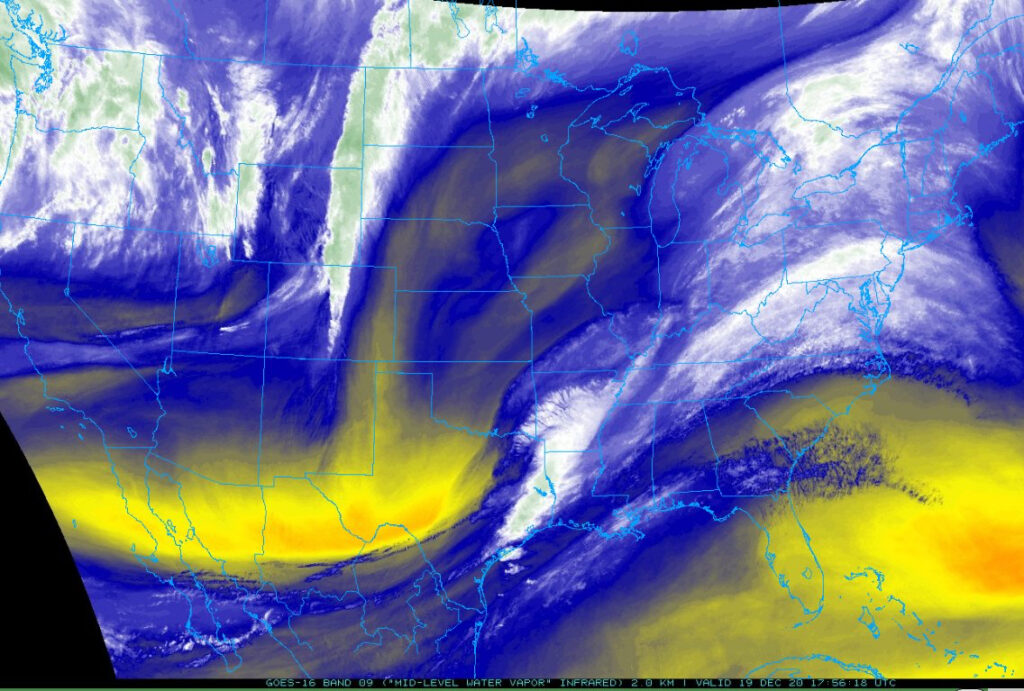
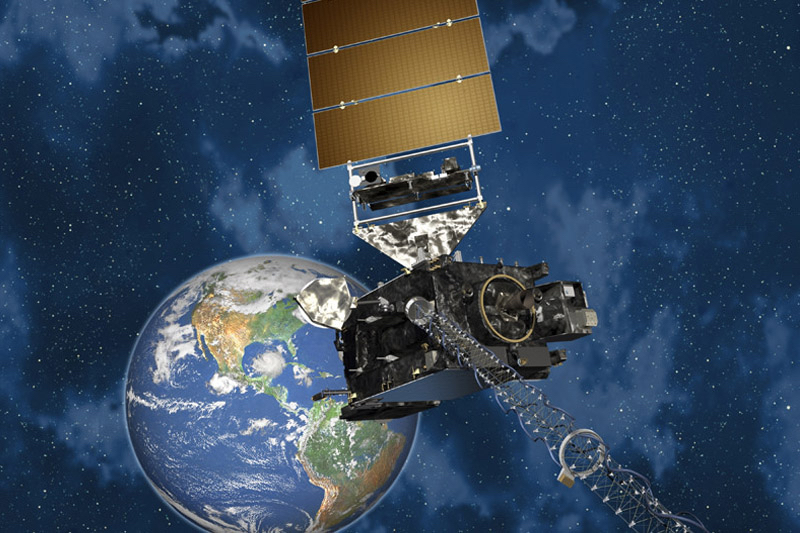
Satellites work by observing outgoing radiation from the Earth’s surface. Satellites can tell meteorologists whether the air is moist or dry, hot or cold, and what direction it’s moving. Most weather satellites are either in Low Earth Orbit or Geostationary Orbit. In Low Earth Orbit, a satellite will pass over a certain point of the Earth, perhaps several times in one day, as the satellite orbits around the planet. In contrast, when a satellite is in Geostationary Orbit, its orbit matches the rotation of the Earth so that it is always above the same part of the surface of the Earth. When a satellite is in Geostationary Orbit, it has a much higher altitude than a satellite that is in Low Earth Orbit. GOES-16 and GOES-17 are examples of weather satellites with a Geostationary Orbit, where GOES-16 is situated over the Eastern U.S. and the Atlantic Ocean, and GOES-17 is situated over the Western U.S. and the Pacific Ocean.
Active vs. Passive Sensing
Satellites are an example of passive sensing in that they can only receive what is already being emitted in terms of radiation. This is in contrast to active sensors such as radars, which send out their own beam of radiation and then listen for it to be sent back to the source. The main disadvantage of passive sensors is that you can only detect what is already being emitted by the Earth and the atmosphere. This means that the visible satellite imagery is only visible during the sunlight hours, when daylight is illuminating that part of the Earth. Satellites are designed to look at other wavelengths of radiation in order to detect clouds and precipitation throughout the day and night. For example, liquid water tends to emit radiation at a very specific wavelength, which is slightly different than frozen water or ice. Some of the lightning channels take advantage of this difference in order to detect what parts of clouds are made of liquid water or ice. In addition, dry air emits radiation at a slightly different wavelength than moist air, and satellites can be tuned to detect a dry airmass in contrast a more moist airmass. These detection methods can be very important for forecasters to predict how certain weather systems will behave and evolve.