
What is Our Atmosphere?
The atmosphere is the air that surrounds the surface of the Earth. It extends to about 100 kilometers/62 miles above the surface of the Earth. Most of the atmosphere is concentrated at the bottom and, in fact, 3/4 of the mass of the atmosphere is located within the lowest 11 kilometers/7 miles. Almost all weather occurs within this lowest part of the atmosphere, which is called the troposphere.
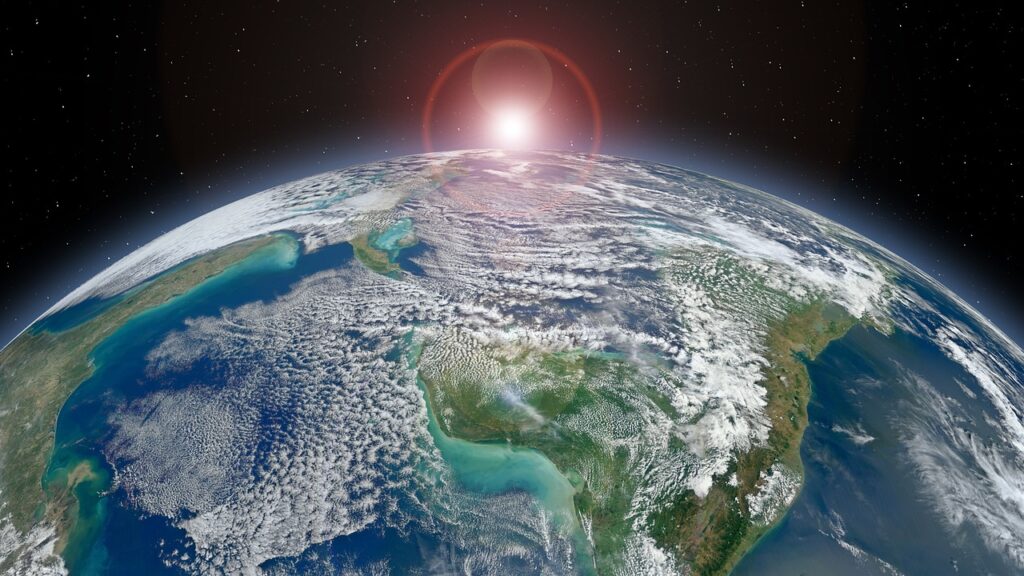
The atmosphere is a fluid, just like any other gas or liquid. Currents flow through the fluid of the atmosphere, just like they would in rivers and streams. These currents in the atmosphere are what leads to common weather patterns across the globe.
What is in our Atmosphere?
The atmosphere is made up of mostly nitrogen, oxygen, argon, carbon dioxide, water vapor, and other gases. Nitrogen is about 78% of the atmosphere, and oxygen makes up about 21%. Water vapor varies depending on whether the atmosphere is dry or moist. When it is moist, water vapor makes up about 1% of the atmosphere by volume.
Most of the mass of the atmosphere is concentrated toward the surface of the Earth. The mass of the column of the atmosphere above any point is measured by atmospheric pressure. For instance, when a weather map says the pressure is 1010 millibars, that means that the weight of the column of air above that point is about 1010 millibars or 14.6 pounds per square inch. Pressure drops off rapidly with height to the point where once you reach 15 kilometers (or about 15% of the height of the atmosphere), only 10% of the pressure remains (or about 1.5 pounds per square inch).
The atmosphere is commonly split into different layers. Most of the mass and weather occurs in the lowest layer, known as the troposphere. The second lowest layer is called the stratosphere. Most planes fly somewhere in the lower stratosphere at cruising altitude. Because of the differing composition of the gases that make up the troposphere and the stratosphere, the stratosphere actually starts to warm with height. This is different from the troposphere, in which air temperature almost always cools with height. This is due to the warmth from the Earth’s surface. The line that separates the troposphere from the stratosphere is called the tropopause. The tropopause is defined by the point at which temperature stops decreasing with height and starts to increase.