
What is Precipitation?
Precipitation is any form of water that falls from our atmosphere. This includes rain, hail, snow, drizzle, graupel, sleet, and more. All of these types of precipitation will be addressed in this lesson.
How Precipitation Forms
All clouds are made of either water or ice. They are made up of very small droplets that are so light that they do not fall to the ground. Eventually, these droplets will begin to run into each other and mash together, until they are so heavy that they eventually fall to the ground as rain. Drizzle is just very small rain droplets.
Interesting Tidbit: When raindrops are falling, they don’t fall in a teardrop shape as they are often shown in cartoons. They actually fall in more of a hamburger or donut shape because the drag friction of the air doesn’t allow a tear drop shape; rather, the friction pushes up on the bottom of the drop to form a hamburger-type shape.
How Does Wintry Precipitation Form?
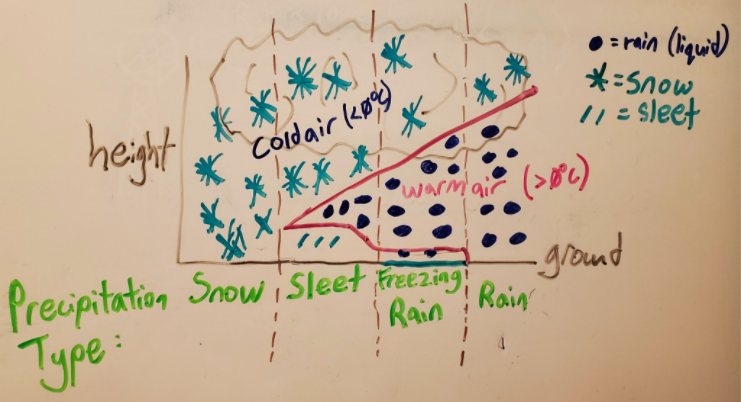
Snow forms in essentially the same way as rain, except the whole column of the atmosphere is below freezing (32 degrees Fahrenheit/0 degrees Celsius). Usually in the atmosphere, it isn’t as simple as either all liquid or all frozen. Even in thunderstorms during the middle summer, there is usually a frozen part near the top, and a liquid part closer to the surface. This is actually necessary for lightning to occur because it depends on liquid water and ice mixing.
Freezing Rain & Sleet
Freezing rain occurs when the precipitation from the cloud falls as rain, but when it reaches the ground, the surface is at or below freezing, causing the liquid rain to freeze on contact. This includes things like roads, trees, and power lines. Freezing rain can be very dangerous because it can lead to accidents, fallen tree limbs, and widespread power outages.
By contrast, sleet occurs when it’s cold enough near the surface to re-freeze the liquid rain before it hits the surface, so it reaches the ground as ice pellets, which we call sleet.
Hail & Graupel
Hail is a form of frozen precipitation that usually occurs in strong thunderstorms. Hail depends on a strong updraft, which causes water from the surface to mix with frozen water in the thunderstorm. The water freezes on contact with the ice crystals (similar to freezing rain), and this continues to grow as long as the updraft can hold it up. This will eventually create what is known as a hailstone, which is essentially a ball of ice. When the hailstone can no longer be supported by the updraft, it will fall to the ground if it does not melt before it reaches the surface. Any hailstone that is approximately an inch or larger in diameter is large enough to cause damage to cars, houses, crops, and livestock.
Interesting Tidbit: The strongest thunderstorms have been known to produce hailstones as large as eight inches in diameter.
Graupel is almost like “baby” hail. Graupel is the soft, icy pellets found in the middle layer of the thunderstorm where ice and water are mixing. Usually, graupel does not make it to the surface. A good example of graupel when it does reach the surface would be during a thunderstorm on a cooler day when what looks to be little pieces of shaved ice begin to mix in with the rain.
These aren’t all the types of precipitation, but these are the most common. See other lessons for more on how thunderstorms form and create these different types of precipitation.